
Understanding the crises
- All staff
- 1 hr incl. quiz
- 7 modules
Why the planet is under strain, and why the crises compound one another.
See the course
Three e-learning courses on the environmental transition. Understand water, materials, living systems and climate, and how they affect what an organisation does. So that everyone can make informed decisions, at their own level.
The three courses build on each other: first understand what is happening, then act where you have leverage.
Why the planet is under strain, and why the crises compound one another.
See the course
What actually matters at a desk, and what changes when resources get tight.
See the course
Assess your exposure, cut impacts and dependencies, design differently, prepare.
See the courseTry a complete module, no sign-up required: the materials crisis. It is exactly the format your teams will receive.
Most transition training talks about carbon. That is necessary, and nowhere near sufficient.
Take one example: decarbonising means electrifying > electrifying means mining copper, lithium and nickel > those mines consume water and destroy habitats. A decision that looks sound against one criterion can be damaging against another. The real risk lies in trade-offs made without the full picture.
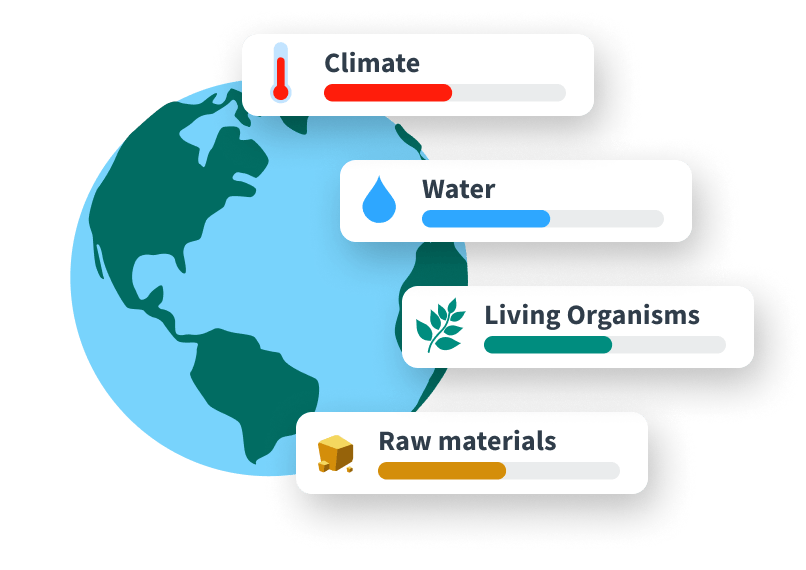
That is why our courses cover four physical dimensions, namely water, materials, living systems and climate, plus two forces that run through all of them: energy, which links resource extraction to climate disruption, and pollution, which damages all four.
We don't hand out off-the-shelf solutions: in a systemic world, there aren't any. We provide the concepts, the orders of magnitude that genuinely land, and the means to look at a problem from several angles at once. The solutions will come from your own teams, provided they are treated as capable adults.

The collection was fully revised in August 2026. Among the updates: the French workplace heat regulation of 27 May 2025, the Omnibus I directive redefining the scope of the CSRD, the first climate tipping point crossed in October 2025, and the IEA's revised critical-minerals deficits.
Green Déclic is a collection by Owls Productions, a digital learning studio with 25 years' experience. We have built training for Airbus, Engie, Orange, Sanofi, Ubisoft, Eiffage and UIMM.
Catherine Bonvalot, engineer (INSA), and Loïc Normand, ENS Arts Décoratifs.
Two specialists contributed to the design of the content: Jérôme Cuny, ecological redirection consultant at IDH21, and Jean-Emmanuel Gilbert, water transition expert and development director at Aquassay.


Whether you want to train your teams or distribute our content in your own catalogue, write to us and we'll reply within two working days.